
Daily Progress Report in Construction: Why DPR Records Matter
What Is a DPR in Construction?
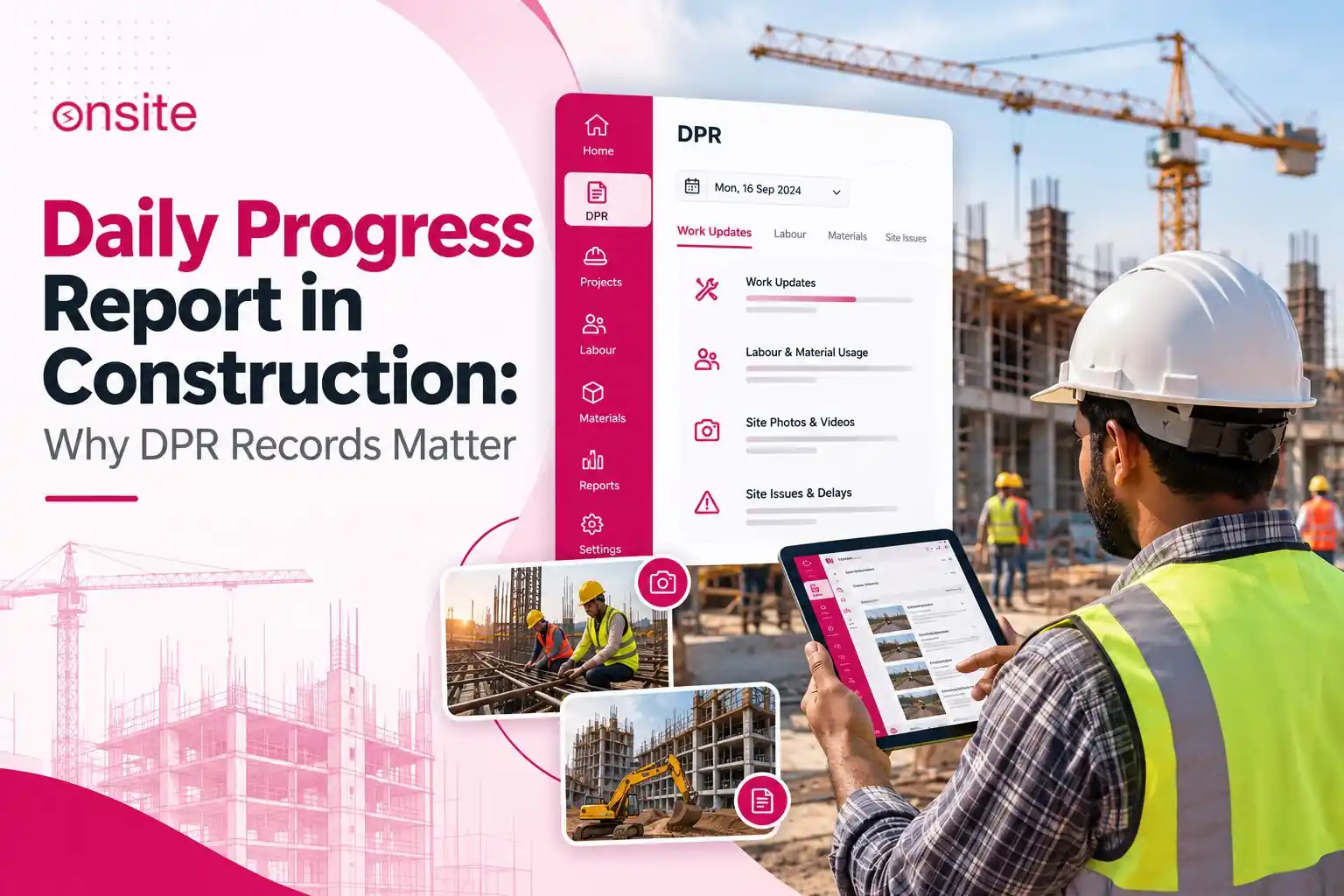
In construction, DPR can refer to two types of documents. The first is a Detailed Project Report, which is a pre-construction planning document prepared before a project is approved. It mainly covers the technical scope, cost estimates, and future plans. The second type is a Daily Progress Report. DPR is commonly known as a Daily Progress Report, which is a document that represents the execution stage and is submitted every day. It covers what was completed on that particular day, which workers were present, what materials were consumed, and what conditions were encountered. It also contains images of the current progress stage along with the relevant context, so the record can be used in the future and serve as evidence of what happened on a particular day. This article is about the Daily Progress Report. For definitions of both types, the construction terms glossary covers each in detail.
Why Does the Daily Progress Report Matter in Construction?
A Daily Progress Report in construction helps inform the project team about what happened on the site that day. If a Daily Progress Report practice is adopted every day with the same structure, it shows how the project is actually performing against the planned schedule. It helps in understanding labour productivity, recurring causes of delays, subcontractor output patterns, and activity execution rates. All of these things become fairly visible when a daily report is prepared consistently. That is where the importance of DPR in construction lies. It is not just an individual report, but an accumulated record of every day.
The DPR’s Value Is Not in Any Single Report
A Daily Progress Report in construction is a document that is submitted every working day. In the majority of sites, it is submitted by the end of the day. It is handed to a project manager or treated as a document that is updated in the company’s system. The project manager uses it to understand what actually happened on the site that day.
It is useful, but this is not where the importance of the DPR ends. In the short term, a DPR being submitted fulfils its immediate function. Its real use lies in the future. What happens to the next 30, 60, or 90 reports actually determines whether the project has a data asset or simply an archive.
A single Daily Progress Report produces data. However, a collection of DPRs produces insight. A team that consistently submits a complete, structured Daily Progress Report every working day for several months has something more than just records. It has a dataset that can answer questions such as:
– Is productivity improving or declining?
– Are delays recurring at the same phase of work?
– Is the subcontractor’s daily output consistent with what it claims at the end of the month?
– Is the current rate of execution sufficient to meet the next programme milestone?
All of these questions can only be answered through a collection of DPRs rather than a single DPR. They can also be answered only through a consistent series of reports.
Generally, it is said that a DPR should contain how many labourers were deployed, the quantities completed, materials consumed, and photographs taken. This article focuses on a different question: What does a project gain when this information is recorded consistently in the same format every working day throughout the project?
The answer is not more data. It is a different kind of information, one that requires time to accumulate before it becomes visible.
What a Series of DPRs Reveals That a Single Report Cannot
A single DPR answers what happened on the site on that particular day. However, a series of DPRs answers whether what is happening today represents an improvement, a deterioration, a pattern, or a situation where the project is falling behind the plan.
Labour productivity trend: Labour deployed on a single day is visible in the daily record. However, the output per worker per day across three weeks is visible only through a series of DPRs. A team consistently deployed with 40 workers but producing progressively less work each day can be identified within two weeks of maintaining consistent records. Without a series of DPRs, however, this trend remains invisible until a milestone is missed.
Recurring causes of lost time: Any kind of problem reported on a single day is an event. However, the same type of problem recorded across 14 out of a total of 90 working days, clustered in a specific month or phase of work, is a pattern. A recognised pattern can be addressed while saving a significant amount of inconvenience. A pattern informs decisions about the remainder of the project. A pattern only becomes visible through a series of DPRs.
Activity execution rate: Measured consistently across multiple daily entries, it shows the rate at which a specific BOQ activity is progressing, making it visible whether the current rate of execution is moving towards or away from the planned milestone. It is not just a scheduling analysis. It is a reading of what the accumulated daily records show.
Subcontractor output: When a particular subcontractor’s daily progress is recorded consistently, a series of DPRs provides another record against which the subcontractor’s reported progress can be reviewed. If a subcontractor claims that they have completed 2,000 square metres during a monthly billing period, the DPRs recorded every working day can be used to review that claim. The daily series is not going to replace the formal measurement exercise, but it provides concrete evidence and a consistent reference point that a single report cannot.
A practical illustration: If 40 workers are deployed every day on a site, a single DPR tells the project manager that 40 workers were present. However, 30 consecutive DPRs inform the project manager whether the same team is producing consistent output, whether manpower shortfalls recur on specific activities, and whether productivity changes after a new supervision approach or work method is introduced. A single report or a weekly meeting cannot reveal what 30 days of consistent daily records can.
Multiple entries of consistent daily reporting can also help reveal material consumption patterns over time. For how daily consumption records connect to the tracking chain from request through consumption, see the construction material tracking articles.
The DPR as the Project’s Institutional Memory
Construction projects keep on changing people. Sometimes, a site engineer gets transferred mid-project. Supervisors move between multiple sites. Project managers get replaced when a scope or ownership changes. Each of these changes in a single project can carry risk.
The knowledge of what happened in earlier phases can go away with the person who is leaving the project, and it may not get transferred at all. This is why institutional memory matters most. When the person who remembers an event is no longer the person managing the project, institutional memory comes into the picture.
If there is a consistent record of DPRs in a project, it can help defend against this loss. A new site engineer may take over a project in month four. The accumulated daily record tells them what the previous engineer documented. A series of Daily Progress Reports provides visibility into everything, activity by activity and day by day. It helps in passing on the knowledge of what output the masonry team achieved on the second-floor walls, which activities fell behind, what reasons were behind the delays, and what instructions were received and on what date. The whole series of DPR records can help answer each of these questions.
The same thing applies when a project is paused or restarted. A project halted for three months and restarted with a different site team requires the past information because the new team has to re-establish the site position, verify what was completed, and plan the mobilisation for the restart. A better-organised record of each working day in the past makes this exercise factual and helps in rebuilding the same project.
The CPWD General Conditions of Contract require contractors on government projects to maintain daily records of work, materials, and labour as a condition of the contract. This particular requirement is there because the project’s contracting authorities need a reliable record of execution. The value of that record extends well beyond the day it is submitted. Producing a DPR each day may take five minutes when the information is being recorded on the day the work happens. However, if it is being recorded later, months later, it can take hours, days, or even weeks.
Reconstruction is always approximate, while the original record is contemporaneous. The cost of that difference is highest when the project most needs precision.
How Daily DPR Records Connect to Project-Level Reporting
A Daily Progress Report shouldn’t exist in isolation. It is actually a document that acts as a source of information. A reporting system is built through this.
A project manager who needs to produce a weekly progress summary doesn’t have to call the site engineer and gather data from people’s memories. Instead, they can use the actual reports recorded on the same day, with fresh data rather than someone’s memory. A monthly client report draws on accumulated daily entries for the period. A programme update comparing planned versus actual progress on each BOQ activity needs daily quantities recorded across the month to make it reliable.
A report becomes very weak if the daily records are inconsistent. These monthly or weekly summaries then become reconstructions rather than aggregations. If the Daily Progress Report is not consistent, the project manager has to work with estimates rather than actual records. The error introduced at the daily level propagates upward into every management report that uses it as a source. Daily records that are consistent, structured, and submitted on time allow construction management reports to be produced quickly and reliably.
What Breaks When DPR Consistency Fails
When DPRs are always inconsistent, not recorded every day, and not submitted consistently, some days being complete and qualified, some days being narrative, and some days being missing, they lose their analytical value. Labour productivity cannot be trended because the denominator changes between entries. A delay pattern cannot be identified because some stoppages are recorded while others are not.
The value of an individual report is largely independent of consistency. The value of a series depends entirely on it. A series with gaps, inconsistent formats, and varying recording standards cannot be analysed. It is probably being made just to be read one entry at a time as a narrative, rather than being treated as a decision-making document.
A project cannot answer every question with inconsistent DPRs. This is also why the problem compounds silently. A project manager who is reviewing everything at the end of the week cannot immediately see what has been lost. The gaps in the record hide things that could eventually become a problem.
Construction DPR Consistency Checklist
The questions below address consistency across the series, not the contents of any individual report.
Daily discipline
☐ DPR submitted on the same day or first thing the following morning — not accumulated and submitted in batches
☐ Labour recorded in the same format each day — by trade or team, not as a total headcount on some days and a breakdown on others
☐ Work completed recorded in the same unit of measurement as the BOQ — not switching between square metres, percentage complete, and narrative descriptions within the same project
☐ Delay cause recorded on the day it occurs — not added retrospectively when preparing a billing claim or delay notice
Series discipline
☐ Use consistent activity names or identifiers so the same work can be compared across dates
☐ Missing days are explicitly noted — a gap in the series is recorded as a non-working day with the reason, not simply absent
☐ If the reporting format changes, preserve the core fields needed to maintain comparability across the project
☐ Photographs are consistently attached to the same categories of activity — not to some days and not others
Handover readiness
☐ The DPR record for any phase of the project can be retrieved and understood by someone who was not present during that phase
☐ Instructions received, delays recorded, and activities completed are identifiable from the record without requiring a verbal account from the engineer who submitted the report
Where Onsite Fits
Onsite helps automate DPRs, so they take only a few minutes to complete rather than hours. Onsite is a construction management software that allows site teams to record daily progress reports from the field and compile those entries into structured DPRs.
Whenever something takes place at a site, the person responsible can simply open the app and update it there. Teams can maintain a usable record throughout the life of the project.
Onsite compiles all of this information, including attendance, progress entries, material usage, subcontractor progress, and so on, with the help of AI into a draft DPR automatically. It reduces the end-of-shift effort that most often causes inconsistent or late submissions.
Conclusion
A DPR is not useful as a single document of a day. It becomes helpful when there is consistency in it and there are a number of DPRs. A series of DPRs helps in producing the right decisions for future activities. It tells a company how productivity is progressing, where time is being lost, whether execution is tracking to plan, and what the project actually looked like during earlier phases.
A project team maintaining DPRs helps in disciplining every working day. It is building one record that accumulates value as a project progresses. That record becomes irreplaceable when the project needs to answer questions about what actually happened, who completed it, and under what conditions. The single report produces the data. The consistent series produces the insight.
FAQs
What is a daily progress report in construction
A daily progress report in construction is a site-level document submitted every working day during project execution. It records what work was completed, which workers were present, what materials were consumed, what equipment was on site, and what issues or delays were encountered. The DPR serves as the primary daily record of project execution, providing both the project team and the project’s stakeholders with a consistent account of what happened on site each day.
What is the difference between a Daily Progress Report and a Detailed Project Report in construction
Both are abbreviated as DPR, but they are entirely different documents. A Detailed Project Report is a pre-construction feasibility document — covering technical scope, cost estimates, and funding plans — submitted before a project is approved. A Daily Progress Report is a site-level execution document submitted every working day during construction. The context usually makes clear which is meant. Construction teams managing active sites are almost always referring to the Daily Progress Report.
Why is DPR important in construction
The importance of DPR in construction comes from the accumulated record it creates over time. A single report tells the project team what happened today. A consistent series reveals how the project is performing — whether productivity is improving or declining, which delays are recurring, whether subcontractor output matches reported progress, and whether the current rate of execution will meet the next programme milestone. That information is not visible in any individual report. It is only visible in the series.
What does a series of DPRs reveal that a single report cannot
A series of consistently maintained daily progress reports can reveal labour productivity trends, recurring causes of lost time, subcontractor output patterns, and the rate at which specific activities are advancing toward planned milestones. A single report tells the project team what happened today. A series of 30 or 60 daily entries shows whether what happened today is part of an improving pattern, a deteriorating one, or a recurring problem that needs to be addressed before it affects the programme.
How does DPR consistency affect project management
When daily records are inconsistent — some days quantified, some narrative, some missing — the series loses its analytical value. Labour productivity cannot be trended. Delay patterns cannot be identified. Subcontractor output cannot be compared across the month. Every higher-level report that uses the DPR as its source becomes a reconstruction rather than an aggregation. DPR discipline — submitting complete, consistently structured entries every working day — is what preserves the series’ value throughout the project.
What should a construction DPR record every day
A construction DPR should record labour deployed by trade or team compared against planned deployment, work completed against BOQ activities with executed quantities, materials received and consumed, equipment on site and operational status, weather conditions where they affected work, and any issues, instructions, or stoppages — with the time and cause noted on the day they occur. Timestamped photographs of completed work should be attached to the specific activities they document, not to the report generally.
How can DPR records help during project handovers or disputes
When a project changes site team, the DPR record tells the incoming team what was completed, in what quantities, and under what conditions — without depending on a verbal account from the departing team. During billing reviews, progress discussions, or commercial disputes, the DPR provides a contemporaneous account of what was recorded on site at the time. Whether a DPR record is relevant to any specific contractual or legal circumstance depends on the contract and the specific situation.
What makes DPR records useful for tracking subcontractor performance
When a subcontractor’s daily progress is recorded consistently in the DPR, the entries across a billing period provide another record against which the subcontractor’s reported progress can be reviewed. A subcontractor claiming a specific quantity of completed work can be compared against the daily entries that cover that period. A consistent daily series provides a reference point that would not exist if the DPR recorded only overall site totals rather than individual team outputs.
